Pozzolanic Activity Index

10.102 –POZZOLANIC ACTIVITY INDEX
(COMPRESSIVE STRENGTH OF MORTARS)
High Reactivity Metakaolin (HRM)
Engineered Mineral Admixture for Use with Portland Cement

Advanced Cement Technologies’ PowerPozz™ High Reactivity Metakaolin is a manufactured pozzolanic mineral admixture which significantly enhances many performance characteristics of cement-based mortars, concretes and related products.

PowerPozz™, derived from purified kaolin clay, is a white, amorphous, alumino-silicate which reacts aggressively with calcium hydroxide, a normal cement hydration byproduct, to form compounds with cementitious value.

Testing Program

Advanced Cement Technologies has performed an evaluation of the performance of PowerPozz™HRM in cement mortars. The purpose of the testing (in accordance with ASTM C-311 / ASTM C-618) was to demonstrate the pozzolanic activity index of PowerPozzTMHRM over that of a control, or in some cases, as compared to other pozzolans.

The evaluations, conducted at the facilities of AGRA Earth and Environmental in Vancouver, B.C., Canada,were conducted in three phases:

In Phase 1, PowerPozz™was used in varying concentrations (5,10, 15%) and compared to the same concentrations of silica fume and to a plain cement control. Strengths and the variations in required superplasticizer dosage were examined.

In Phase 2, the mixes were produced with a range of different pozzolans, including PowerPozz™without superplasticizers. The water addition and therefore water to binder ratios were allowed to vary to achieve similar flows. Effects on water demand and strength were examined.

In Phase 3, the compressive strength of a plain cement mortar was compared with the strength gain of a mortar in which 10% of the cement was replaced with PowerPozzTMHRM. In this study, a dry superplasticizer was added to both the control and the test mixes at a constant dosage. Both the control and test mixes were produced at a water / binder ratio of 0.40 and a sand / binder ratio of 2.75. Compressive strengths presented are the averages for 3 cubes at each of the 4 age intervals (1,3,7,28 days).

PHASE 1

Methodology

In this study, 9 mortar mixes were produced: Two of the mixes were Class F Flyash/HRM combinations and will be reported separately. For the remaining 7 mixes, the following cementitious materials were used:

Mix 1:Type 1 Ordinary Portland Cement (Control)
Mix 2:OPC / 5% PowerPozz™HRM
Mix 3:OPC / 10% PowerPozz™HRM
Mix 4:OPC / 15% PowerPozz™HRM
Mix 5:OPC / 5% Silica Fume
Mix 6:OPC / 10% Silica Fume
Mix 7:OPC / 15% Silica Fume

The percentages of supplemenntary cementing materials were replacementsby weight of portland cement, not additions.

The mortars were produced with a water : binder ratio of 0.40.

The compressive strength results reported are the averages of two cubes.

Phase 1 Results

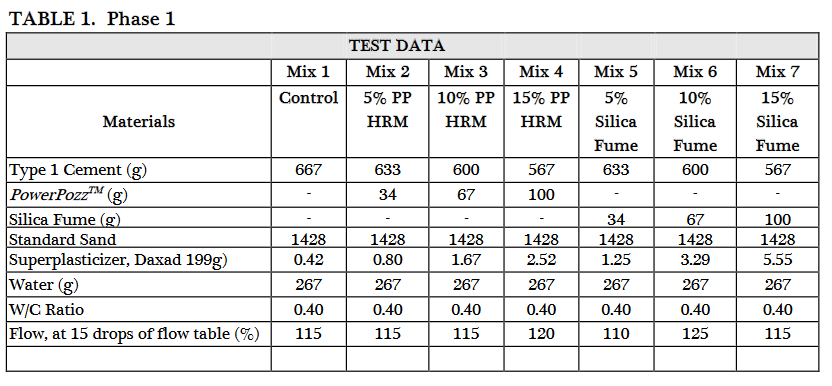
Results from Phase 1 are reported in Table 1.

Project: Comparative Strength Testing of PowerPozz™High Reactivity Metakaolin

Subject: Strength Activity Index with Portland Cement (ASTM C-311)
Phase 1 Results & Discussion

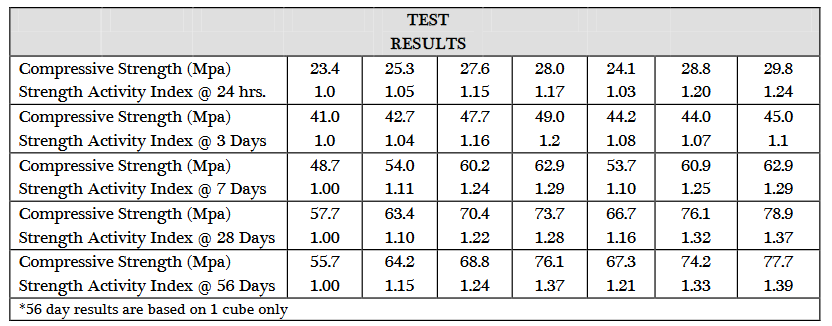
The results show that both mineral admixtures show progressive increases in strength with increasing percentages of replacement, up to the 15% level.

With PowerPozz™at 5% replacement, the strength increase is 10% over control. At 10% and 15% replacements, PowerPozz™contributed to 22% and 28% gains respectively as compared to the control mix.

The results indicate that increasing loading rates of PowerPozz™contribute to higher strengths.

These results also indicate that PowerPozz™is most efficient within the range of 10 +2%. At 5% PowerPozz™, a 2% increase in strength is realized per percent PowerPozz™. This increases to a 2.2% increase in strength per percent PowerPozz™at 10% replacement and decreases slightly to 1.9% per percent PowerPozz™at the 15% replacement level.

In comparing the PowerPozz™HRM mixes to those produced with silica fume, PowerPozz™mortars were generally stronger at three days, approximately the same at seven days and slightly lower at 28 days.

These results show that PowerPozz™is comparable to silica fume in terms ofcompressive strength development but does so with a much lower water demand. Therefore, the PowerPozz™mortars required a significantly lower (half) dosage of superplasticizer to maintain flow and stable water: cementitious ratio. The pozzolanic activity results withoutthe use of superplasticizers are examined in Phase 2.

It was observed that with PowerPozz™being white in color, it produced mortars which were fairly normal in appearance, whereas those produced with silica fume had a characteristic dark gray color.

PHASE 2

Methodology

In the second study, the mortars were produced in accordance withASTM C-311.One control (plain OPC) mix was produced, and all other supplementary cementing materials were used at 7.5% replacement by weight of cement.

Five mixes are reported here. Of the five mixes one was the control, one included silica fume, andthree were produced with metakaolins. Of the three HRM products used, one is PowerPozz™, and the other two are other commercially available metakaolins.

Mix 1:OPC -Ordinary Portland Cement (Control)
Mix 2:OPC / Metakaolin A
Mix 3:OPC / Metakaolin B
Mix 4:OPC / PowerPozz™
Mix 5:OPC / Silica Fume

The control mixwas produced with a water : cement ratio of 0.48. The subsequent mixes containing the supplementary cementing materials had constant cementitious contents with water being adjusted to achieve a flow similar to the control mix. As a result, the water : binder ratios for the HRM and silica fume mixes varied. No water-reducing admixtures were used in this Phase.

Phase 2 Results

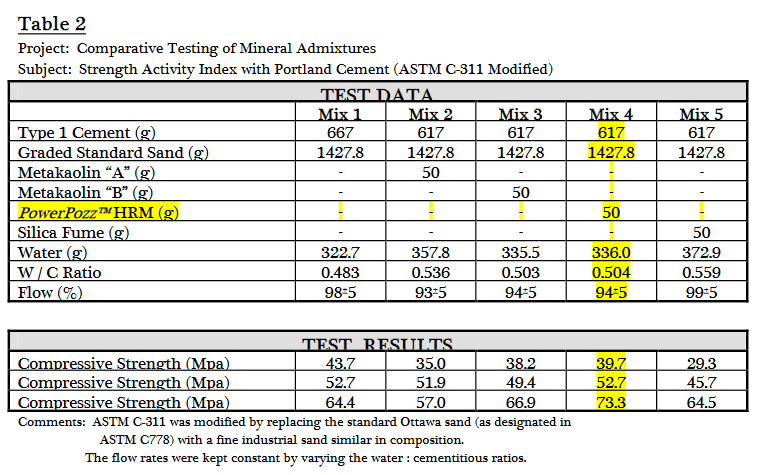
The results of the tests for Phase 2 are presented in Table2.

The control mix had the lowest water : cementitious ratio, and the silica fume mix had the highest.

The greatest strength was achieved with 7.5% replacement with PowerPozz™.

The silica fume mix, with a relatively high water demand and w / c ratio, had strengths similar to control. For this reason, silica fume is seldom, if ever, used or recommended without superplasticizing admixtures.
Phase 2 Results & Discussion

The PowerPozz™mix showed a much lower water demandthan those produced with silica fume. If this effect is compensated for by employing superplasticizing admixtures, as in Phase 1, the silica fume can produce somewhat higher strengths, but with a much higher dosage of superplasticizer.

Products produced with PowerPozz™or other metakaolins are significantly lighter in colorthan those produced with silica fume at normal addition rates.

The 28-day compressive strengthof the mortar containing 7.5% PowerPozz™, with no superplasticizers, at a 0.40 water : cement ratio exceeded all samplestested in Phase 1.

At 7.5% replacement, the PowerPozz™mortar was 9.6% higher in compressive strength than other metakaolin samples, and was 13.6% higher than the silica fume and control mortars.

PHASE 3

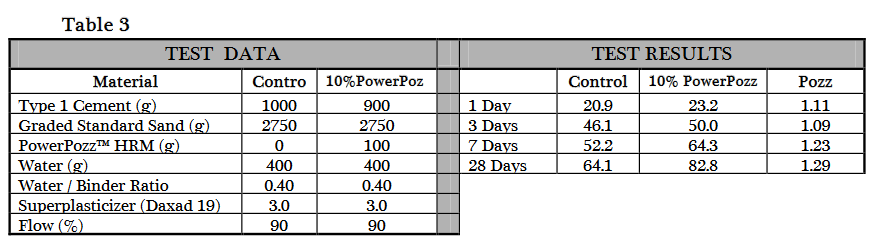
In this phase, the compressive strength of a plain cement mortar was compared with the strength gain of a mortar in which 10% of the cement was replaced with PowerPozzTMHRM. In this study, a dry superplasticizer was added to both the control and the test mixes, and all were produced at a water / binder ratio of 0.40 and a sand / binder ratio of 2.75. Compressive strengths presented are the averages for 3 cubes at each of the 4 age intervals (1,3,7,28 days).
Phase 3 -Results & Discussion

It is noteworthy that even with a 10% replacement of cement by 1:1 substitution of pozzolan (metakaolin) the early strengths(1,3 Days) demonstrated a positive (>1) index over control. This is indicative of the early reactivity of PowerPozzTMHRM. The early age pozzolanic reactivity and strength performance is a unique and defining feature of metakaolin, as compared to other pozzolanic materials.

It is also apparent from these results that HRM continues to indicate increasing pozzolanic reactivity at an increasing rate within the 28-day period of study. It would be normal to expect that the strength gain differential between the HRM test mix and the plain cement control will continue to widen over the long run of time. This conclusion has been made through our own research and is well corroborated by others with regard to pozzolans in general, and also specifically where HRM and like materials are concerned.

The high pozzolanic reactivityof PowerPozzTMHRM makes it, of course, an important input ingredient for the formulation of high strength materials. In fact, when mix design options with and without HRM are examined, it is normal to find that to increase the strength of a performance concrete, it is often more efficient to utilize HRM than to increase the cement content.

For concretes within the normal designcompressive strength range, the performance advantages of HRM may also be important (i.e.: low permeability, high chemical resistivity, corrosion mitigation, control of efflorescence or ASR, etc.). In these mix designs, it may be possible to use HRM as asubstitute for cement, for example at a 10% wt cement replacement level, and also reduce the total cementitious content of the mix and still met the design strength requirements comfortably.

These figures and examples are presented for illustrative and descriptive purposes only. Only a properly conducted trial batch and testing program.

will determine actual performance for a particular mix design, application, or set of raw materials.

Ask your ACT representative for assistance in the development of mix designs with metakaolin.

PowerPozz™is a mineral admixture, which offers excellent performance and can contribute to the manufacture of high strength, high durability mortars, concretes and related portland cement-based products.

All information, while provided in good faith, with every effort made to assure accuracy, is provided by Advanced Cement Technologies at no charge, and with warranty–express or implied. Data given, unless otherwise stated, are based on standard testing procedures which are available on request. Variations do occur in individual tests and the results stated herein cannot be taken for minima or maxima for specification purposes.

As we cannot anticipate all possible applications of our product, nor variations in manufacturing equipment, formulae, methods, or practices, we guarantee only that the product will meet the specifications of Advanced Cement Technologies at the time of sale. Advanced Cement Technologies reserves the right to change specifications should it becomenecessary. The product is sold without express or implied warranty, with all warranties of fitness of purpose and merchantability being disclaimed, and on condition that the purchaser is responsible for the determination of the product’s suitability for a particular purpose.

Statements concerning the possible use of our product are not intended as recommendations for use. No liability is accepted for any infringements of any existing or future patents.

All products sold, unless otherwise stated, will besubject to general sales conditions, which are supplied with all quotations and order confirmations.

Applications & Benefits

10.108 – APPLICATIONS AND BENEFITS

PowerPozz High Reactivity Metakaolin has been successfully incorporated into applications for concrete and related products throughout North America and the international marketplace. The following sections will describe many of those applications and the benefits that were achieved through the use of PowerPozz.

Federal and State DOT Infrastructure Projects

Meets Engineering Specifications for High Performance, High Strength, and Lightweight Concrete.

  • Bridges (structural and non structural components)
  • Pavement Overlays
  • Water Supply and Marine

Benefits

  • Reduced Permeability
  • Increased Strength and Durability
  •  Prevention of ASR

Precast and Repetitive Concrete Products

  • Precast
  • Cast Stone
  • Block, Brick, and Paving Stones

Benefits

  • Increased Strength and Durability
  • Reduced Permeability and Efflorescence
  • Improved color and Appearance

Fibercement Products, Ferrocement, and Glass Fiber Reinforced Concret

  • Roofing Products

Benefits

  • Reduced Drying Shrinkage
  •  Reduced Overall Permeability
  • Improved Strength and Toughness

Dry Bagged Products

  • Mortars
  •  Stuccos
  •  Repair Materials
  •  Pool Plaster

Benefits

  • Reduced Permeability and Efflorescence
  • Improved Finishability, Color and Appearance

Specialty Uses

  • Blended Cements
  • Oil Well Cementing
  • Shotcrete
  • Decorative Interior Concrete Fixtures
  • Sculpture

PowerPozz High Reactivity Metakaolin has proven itself to be a highly versatile and effective concrete additive. It has been, and will continue to be, an important component in the modern world of construction. Companies and researchers around the world are now looking at new and innovative uses for this material. We can’t wait to see where it will take us next.

General Use

10.101 -GENERAL USE
High Reactivity Metakaolin (HRM)
Engineered Mineral Admixture For Use With Portland Cement

USE PowerPozz™ in:

  • High Performance, High Strengthand Lightweightconcrete
  • Precast Concrete for Architectural, Civil, Industrial, and Structural
  • Fibercementand Ferrocement products, Glass Fiber Reinforced Concrete
  • Mortars, Stuccos, Repair Material, Pool Plasters
  • Manufactured Repetitive Concrete Products

USE PowerPozz™for:

  • Increased Compressive & Flexural Strengths
  • Reduced Permeability & Efflorescence
  • Increased Resistance to Chemical Attack& Prevention of ASR
  • Reduced Shrinkage
  • Improved Finishability, Color& Appearance

USING PowerPozz™:

PowerPozz™ should be used in terms of total cement weight at 5-15% loading rate. Tests have shown that for optimum pozzolanic reactivity with Ca(OH2), an 8% replacement is efficient. For prevention of ASR or efflorescence, as well as for enhanced durability in GFRC, higher loading rates, up to 15% by weight of cement may prove to be most effective.

In terms of concrete works, as always, good production and construction practices must be observed. Most importantly the water/cement ratio must be controlled. When using PowerPozz™in concrete, the use of superplasticizers, entrained air, and/or fly ash is recommended to help increase and maintain placement slumps without increasing the water content. Ask your ACT representative for assistance in testing and optimizing your formulation.

CEMENT REPLACEMENT / ADDITION

PowerPozz™substituted directly for or added to OPC at 5 -15% by weight will:

  • Greatly reduce porosity and permeability
  • Increase early (1-28 day) compressive strengths
  • Improve late (56+ day) strengths
  • Provide long term durability where ASR is a concern
  • Reduce occurrence of efflorescence
  • Provide enhanced resistance to chemical attack (sulfates, chlorides, acids).

POZZOLANIC SUBSTITUTION

If you are already using a high performing pozzolan in your production (i.e. silica fume/microsilica) PowerPozz™can be substituted directly. In terms of compressive strength, a reduction of the addition rate of PowerPozz™may be possible for equivalent performance. Testing with specific cements, aggregates, admixtures, etc., is strongly recommended to confirm appropriate proportioning. Further, the potential to reduce the dosage of superplasticizer required in a PowerPozz™formulation from that of a comparable silica fume mix is possible.

Substituting PowerPozz™for silica fume in existing formulationswill:

  • Maintain or increase compressive strengths at early ages (1-28 days),
  • Maintain long term compressive strength development (>28 days),
  • Disperse more easily in the mixer with less dust,
  • Not darken the color of the paste or mortar, and
  • Reduce superplasticizer demand for the target slump.

PowerPozz™is compatible with chemical admixtures, as well as with other pozzolans and supplementary cementing materials, i.e.: fly ash, ground granulated blast furnace slag.

Metakaolin Description

METAKAOLIN DESCRIPTION
High Reactivity Metakaolin (HRM)
Engineered Mineral Admixture for Use with Portland Cement

Advanced Cement Technologies’ PowerPozz™ High Reactivity Metakaolin is a manufactured pozzolanic mineral admixture, which significantly enhances many performance characteristics of cement-based mortars, concretes and related products.

PowerPozz™, derived from purified kaolin clay, is a white, amorphous, alumino-silicate, which reacts aggressively with calcium hydroxide, a normal cement hydration byproduct, to form compounds with cementitious value.

Produced to ISO 9002 certification standards, PowerPozz™ HRM is subjected to strict process quality control to assure product uniformity and consistent performance.

Used at 5 – 15% replacement of cement by weight, PowerPozz™ will contribute to: increased strength; reduced permeability; greater durability; effective control of efflorescence; and control of degradation caused by Alkali-Silica Reaction (ASR).

Raw Materials

The raw material input in the manufacture of metakaolin is kaolin clay.

Kaolin is a fine, white, clay mineral that has been traditionally used in the manufacture of porcelain. It is thought that the term kaolin is derived from the Chinese Kaoling, which translates loosely to white hill and has been related to the name of a mountain in China that yielded the first kaolins that were sent to Europe.

Kaolinite is the mineralogical term that is applicable to kaolin clays. Kaolinite is defined as a common mineral, hydrated aluminum disilicate, Al2Si2O5(OH)4, the most common constituent of kaolin.

Kaolins are a classification of clay minerals, which like all clays, are phyllosilicates, i.e.: a layer silicate material. The study of the stacked arrangement and the individual layers in the stack are the defining factors of classification.

Kaolin is a mineral typical of continental weathering where solutions percolate and are purified over time. Kaolinite cannot develop in sedimentary basins where solutions accumulate and are enriched.

Kaolin is one of the more highly prized of the industri al mineral clays. Kaolin’s traditional markets in ceramics over the past centuries have yielded to the now dominant consumption by the paper industry where it is extensively used as a filler, opacifier, and as an important input to high-end coatings. Additional, smaller markets for kaolin are in the refractory, rubber, paint, plastic, chemical, pharmaceutical and ceramic industries.

Metakaolin

The meta prefix in the term is used to denote change. It is a borrowing from Greek meaning after, along with, beyond. It is used, and is recognizable, in the formation of compound words: metabolic, metamorphosis. The scientific use of the prefix is used for a combining form denoting the least hydrated of a series.

In the case of metakaolin, the change that is taking place is dehydroxylization, brought on by the application of heat over a defined period of time.

At about 100-200 degrees C, clay minerals lose most of their adsorbed water. The temperature at which kaolinite loses water by dehydroxilization is in the range of 500-800 degrees C. This thermal activation of a mineral is also referred to as calcining. Beyond the temperature of dehydroxylization, kaolinite retains two-dimensional order in the crystal structure and the product is termed metakaolin.

The key in producing metakaolin for use as a supplementary cementing material, or pozzolan is to achieve as near to complete dehydroxilization as possible without over heating. Successful processing results in a disordered, amorphous state, which is highly pozzolanic. Thermal exposure beyond a defined point will result in sintering and the formation of mullite, which is dead burnt and not reactive. In other words, kaolinite, to be optimally altered to a metakaolin state, requires that it is thoroughly roasted but never burnt.

New Age Concrete

The construction industry has taken considerable strides forward over the last two or three decades with regard to many materials, in particular – High Strength Concrete (HSC) and generally Higher Performing Concrete Materials.

The development of new technology in the materials sciences is progressing rapidly. Advanced composite construction materials and HSC are gaining wide acceptance in the construction industry of today, and are well positioned for increasing proliferation in use in the future. HSC and High Performance Cement-Based Products will continue to make important contributions to the enhanced quality and efficiency in the construction of infrastructure and our communities in the next century.

PowerPozz™ High Reactivity Metakaolin

The use of pozzolanic materials in the manufacture of concrete has a long, successful history. In fact, their use pre-dates the invention of modern day portland cement by almost 2,000 years.

Today, most concrete producers worldwide recognize the value of pozzolanic enhancements to their products and, where they are available, they are becoming a basic, even a routine, concrete ingredient.

Most pozzolans used in the world today are byproducts from other industries, such as coal fly ash, blast furnace slag, rice hull ash, or silica fume. As such, there has been relatively little work done with regard to manufactured, optimized and engineered pozzolanic materials which are specifically intended for use in portland cement-based formulations. PowerPozz™ High Reactivity Metakaolin is a leader among a new generation of such materials.

The use of silica fume and various chemical admixtures have become staple ingredients in the production of concretes with designed strengths in excess of 7500 psi (>50 Mpa) or where service environments, exposure conditions, or life cycle cost considerations dictate the use of High Performance Concrete (HPC).

The introduction of High Reactivity Metakaolin to the HSC market has provided an alternative to the use of silica fume. Equivalence in strength development and durability properties along with several additional features of HRM including color and workability have effectively expanded the design boundaries of HPC materials.

The benefits in engineering properties that result from the use of PowerPozz™ HRM come with few “side effects”. Once properly adjusted, the concrete fresh mix texture, workability and finishability are generally enhanced by the replacement of 5-15% of cement with HRM.

PowerPozz™ is white in color and will not darken pigmented, gray or white cement-based concrete or products. Easy to handle in trucks, silos and plants,


Phys & Chem Properties – White

10.150 – PHYSICAL & CHEMICAL PROPERTIES
GRADE – WHITE
High Reactivity Metakaolin (HRM)

Advanced Cement Technologies’ PowerPozz™ HRM is a manufactured pozzolanic mineral admixture which significantly enhances many performance characteristics of cement-based mortars,
concretes and related products.

PowerPozz™, derived from purified kaolin clay, is a white, amorphous, alumino-silicate which reacts aggressively with calcium hydroxide to form compounds with cementitious value.

Used at 5-15% replacement of cement by weight, PowerPozz™ will contribute to: increased strength, reduced permeability, greater durability and effective control of efflorescence and
degradations caused by alkali-silica reaction (ASR) in concrete.

Description:
A white, manufactured, amorphous alumino-silicate with excellent physical, chemical and pozzolanic properties. Conforms to ASTM C-618, Class N Specifications for Natural and Calcined Pozzolans.

Physical Properties:

  • Specific Gravity: 2.2
  • Physical Form: Amorphous
  • Color: Cream White
  • Average Particle Size: 1.5 um
  • Bulk Density (lbs/ft 3 ): 18-22

Chemical Composition, Wt.:

  • SiO 2 51-52.4%
  • Al 2 O 3 42.1-44.3%
  • Fe 2 O 3 0.30-0.50%
  • TiO 2 1.56-2.50%
  • pH (20% Solids) 4.0


All information, while provided in good faith, with every effort made to assure accuracy, is provided by Advanced Cement Technologies at no charge and without warranty–express or implied. Data given, unless otherwise stated, are based on standard testing procedures, which are available upon request. Variations do occur in individual tests, and the results stated herein cannot be taken as minima or maxima for specification purposes.